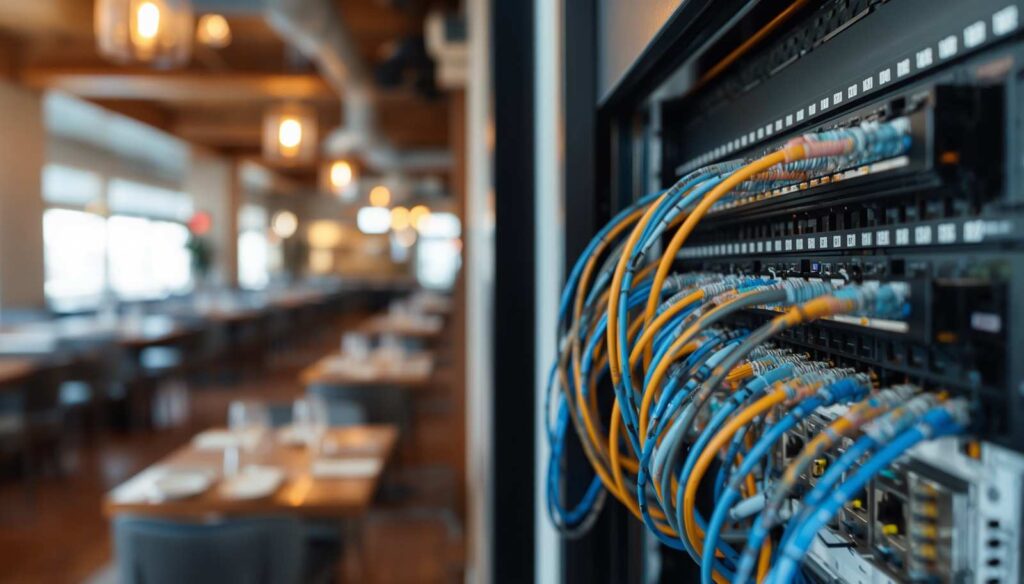
Restaurant Network Cabling in Houston: What Every Owner Should Know
When it comes to restaurant network cabling in Houston, the trouble usually shows up on your busiest Friday. Dining room packed, a line out the door, four tickets deep on the kitchen screen. A server goes to close a check and the card reader just… hangs. Then another. Now the front of house is stalled, tables aren’t turning, and the manager is on hold with support while the wait times climb. Here’s the part most owners don’t realize until it happens to them: that mess almost never starts at the terminal. It starts in the wiring behind the wall, the stuff nobody thinks about because you can’t see it. In a restaurant, that low-voltage cabling is quietly carrying your payments, your kitchen tickets, your WiFi, your music, and your cameras all at once. Do it right and you’ll forget it exists. Do it cheap and it’ll pick the worst possible night to remind you. So let’s talk about what restaurant cabling actually involves, why it’s a different job than wiring an office, and what separates an install you can trust from one you’ll be redoing in a year. Restaurant Network Cabling in Houston Is a Rough Job An office is easy. Desks don’t move, the air is cool and dry, and if someone’s connection drops they reboot and get back to their spreadsheet. A restaurant gives cable a much harder life. Think about where the runs actually go. Over the line, where it’s hot and greasy. Near the dish pit, where there’s steam and spray. Through ceilings that also have to satisfy the health inspector and the fire marshal. And it all has to survive a payment system that cannot afford to blink during a 200-cover dinner rush. A dropped connection here isn’t an annoyance. It’s lost sales, blown table turns, and a guest deciding they won’t be back. There’s one more thing people miss. In a restaurant, everything shares the same nervous system. Your POS terminals, kitchen display screens, receipt and kitchen printers, card readers, access points, background music, security cameras, they all lean on the same low-voltage backbone. So when the cabling has a weak spot, it doesn’t fail in one tidy place. It shows up as a dozen little gremlins across every system, and good luck figuring out which cable is the culprit at 8 p.m. on a Saturday. That’s exactly why real structured commercial cabling matters more in a restaurant than in almost any other kind of business. The Thing Toast Won’t Tell You Up Front Here’s something worth knowing before you sign your Toast contract. Toast will handle a lot, but their installers draw a hard line at the cabling. Per Toast’s own network requirements, their techs won’t run cable more than about ten feet, won’t go through walls, and won’t touch crawl spaces or open ceiling areas, because building codes for that kind of work vary and it’s not their job. Read that again, because it matters. The cabling between your equipment room and every terminal, printer, and access point in the building? That’s on you to sort out before install day. Show up without it and you’re looking at delays, or worse, a rushed cable job done by whoever’s cheapest. Toast is also pretty specific about how they want the network built. They want the POS on its own separate VLAN, walled off from guest WiFi and everything else, so a full dining room streaming video never bogs down your terminals. They want Cat5e or better, terminated to the proper standard. And they want handhelds on the 5GHz band, because 2.4GHz is a traffic jam of phones and kitchen equipment all fighting for the same air. None of that happens by accident. Somebody has to plan it and build it, and that somebody is a cabling contractor, not the Toast rep. Four Systems, One Backbone When people say “the network,” they usually just mean WiFi. But in a restaurant the cabling is doing a lot more heavy lifting than getting guests online. Your Toast POS is the big one. Terminals, card readers, receipt printers, kitchen printers, they all run best hardwired, not on WiFi. A proper install puts a dedicated drop at every station: the bar, the host stand, each server terminal, the kitchen. Nothing important should have to fight its way across the room on a wireless signal. Then there’s the WiFi itself. Guest WiFi and back-of-house WiFi should never share a lane. You want commercial business WiFi with access points placed to actually cover the floor, no dead zone at corner booth number six, and the guest traffic kept separate so a busy dining room streaming isn’t slowing down your handhelds. And every one of those access points is only as good as the cable feeding it. Bad drop, bad WiFi. Simple as that. Audio is easy to overlook until it’s wrong. Nothing sours the mood like music that crackles, jumps in volume between the patio and the bar, or comes with a rat’s nest of speaker wire in plain sight. A clean commercial audio setup gets wired into the same plan as everything else so each space sounds the way it should. And don’t forget the rest of it. Cameras, phones, whatever comes next. Pull those cables while the ceiling is open and the walls are still apart. Skip it now and you’ll be paying someone to cut into a finished ceiling later to add a run you should’ve planned for. What Cheap Cabling Really Costs The thing about a bad cable job is that it looks fine on day one. It passes the eyeball test, everything powers on, and then it falls apart the moment you get busy. A wire crimped in the wrong order gives you a terminal that’s slow or just dead. Access points slapped up wherever they fit instead of where they belong leave you with dead zones right where you seat your best tables. Cables run alongside power lines pick up interference that quietly drags everything down. And when nothing’s labeled and nobody documented